Nigeria’s Vice President, Kashim Shettima, has called on African countries to move away from the long-standing practice of exporting raw materials and instead focus on building industries that process the continent’s natural resources into finished products with higher economic value.
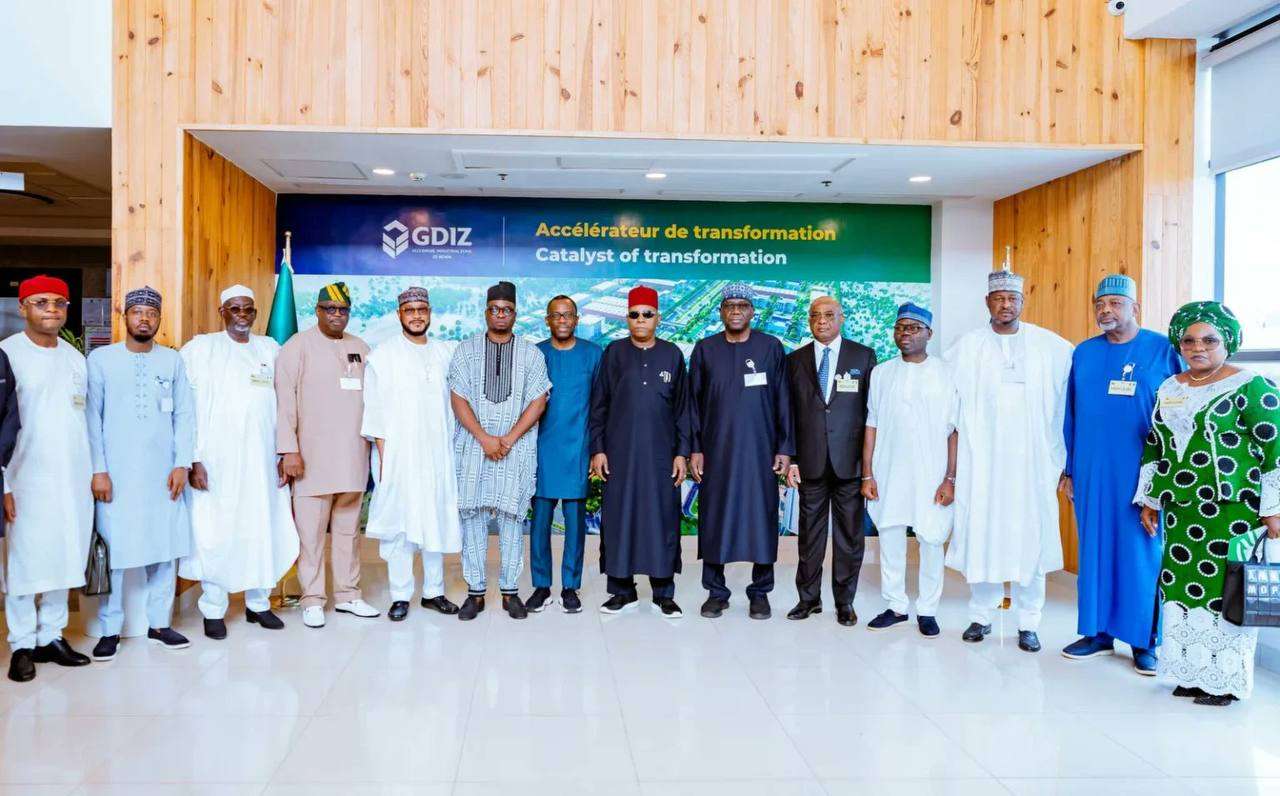
Shettima made the remarks on Friday during a visit to the Glo-Djigbé Industrial Zone (GDIZ) in Cotonou, Republic of Benin, where he toured several manufacturing and agro-processing facilities as part of Nigeria’s efforts to study successful industrial development models across Africa.
According to the Vice President, Africa possesses enormous natural resources but continues to earn only a fraction of their true economic value because much of the continent’s raw materials are exported without local processing.
He stressed that African nations must take greater control of their resources and strengthen domestic industries capable of transforming agricultural and mineral products into finished goods that can compete in global markets.
Shettima noted that the Federal Government, under President Bola Ahmed Tinubu’s Renewed Hope Agenda, is committed to accelerating Nigeria’s industrialization while ensuring that every region of the country benefits from the economic transformation.
He praised the Republic of Benin for developing an integrated industrial ecosystem that adds value to locally sourced raw materials before export, describing the country’s approach as an example worthy of replication across Africa.
The Vice President expressed particular concern over Africa’s limited participation in the global cotton industry, despite the continent being one of the world’s major producers of cotton.
According to him, Africa currently captures only about one percent of the global cotton industry, valued at approximately $370 billion, highlighting the urgent need for greater investment in textile manufacturing and value addition.
He explained that revitalizing Nigeria’s textile industry could generate millions of jobs, increase non-oil export earnings, stimulate industrial growth, and strengthen the country’s overall economy.
During the visit, Shettima inspected facilities involved in cotton processing, textile manufacturing, cashew processing, and soybean oil production. The industrial zone demonstrated how locally produced agricultural commodities are converted into finished products ready for domestic use and international export.
Speaking after the tour, the Vice President said the Nigerian delegation was visiting Benin on the directive of President Tinubu to study global best practices and identify successful industrial models that could be adapted to Nigeria.
He revealed that Nigeria is currently developing eight agro-industrial zones across eight states as part of broader efforts to improve agricultural processing, attract investment, and expand manufacturing capacity.
According to Shettima, the Glo-Djigbé Industrial Zone represents an African success story because it has successfully integrated agriculture with manufacturing by creating complete value chains for products such as cotton, cashew, and soybean.
He expressed confidence that the lessons learned during the visit would help Nigeria strengthen its own industrial policies and promote local value addition across key sectors of the economy.
The Vice President reaffirmed the Federal Government’s determination to position Nigeria among the world’s leading industrial economies by encouraging local production, boosting exports, and reducing dependence on raw material exports.
During the visit, Nigerian officials received detailed briefings from Benin’s Minister of Tourism and Foreign Trade on the industrial zone’s operational structure, production capacity, and investment opportunities. The delegation also toured modern textile factories where locally grown cotton is processed into yarn, fabric, and finished garments, alongside facilities dedicated to processing cashew nuts and other agricultural products.
The visit forms part of Nigeria’s broader strategy to strengthen industrial development, promote manufacturing, attract private sector investment, and create sustainable value chains that maximize the economic benefits of the country’s natural resources.
Accompanying the Vice President on the tour were the governors of Kwara, Imo, Katsina, Plateau, Zamfara, and Jigawa States, underscoring the collaborative approach between the Federal Government and state governments in advancing Nigeria’s industrialization agenda.
Discover more from Scoop Hub
Subscribe to get the latest posts sent to your email.