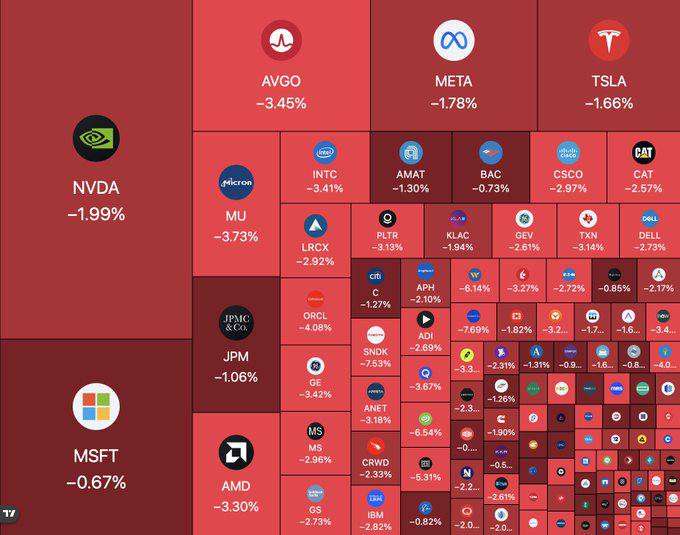
Wall Street came under pressure on Monday as investors reacted to renewed geopolitical tensions in the Middle East following President Donald Trump’s decision to reinstate the United States blockade of Iranian ships passing through the Strait of Hormuz. The move sparked fresh concerns about global energy supplies, sending oil prices higher and weighing on major US stock indexes.
By mid-afternoon trading in New York, the S&P 500 had fallen 0.7%, putting the benchmark on course to end its two-day winning streak. The technology-heavy Nasdaq 100 recorded a steeper decline of 1.8%, while Brent crude oil climbed to approximately $83 per barrel as traders assessed the potential impact of disruptions in one of the world’s most critical shipping routes.
Market analysts noted that although oil prices increased following the latest developments, investors have remained relatively composed compared to previous geopolitical crises. Chris Beauchamp, Chief Market Analyst at IG, said the market’s reaction has been measured despite the significant risks surrounding global oil supply.
President Trump announced on social media that the United States would receive reimbursement equivalent to 20% of all cargo transported through the Strait of Hormuz. The renewed blockade follows weeks of escalating military exchanges between the United States and Iran, alongside conflicting reports regarding the security of the strategic waterway.
According to the US Central Command, American forces recently carried out coordinated strikes targeting dozens of Iranian military positions believed to threaten commercial shipping in the Strait of Hormuz. Iran responded on Monday by launching attacks against US allies across the Persian Gulf, reportedly targeting American military installations in Kuwait, Bahrain, Jordan and Oman, according to Iranian state media.
The renewed hostilities have weakened hopes for a diplomatic resolution to a conflict that has unsettled global financial markets since February. Investors are increasingly worried that rising energy prices could fuel inflation, complicating efforts by central banks to stabilize economic growth.
Despite the latest market decline, US equities have remained relatively resilient throughout the year, supported largely by the ongoing artificial intelligence boom and strong performances from sectors such as energy and industrials. However, technology stocks have recently lost momentum as investors reassess valuations amid persistent inflation concerns and the possibility of higher interest rates.
The information technology sector emerged as the weakest performer within the S&P 500 during Monday’s trading session. Paul Christopher, Head of Global Investment Strategy at Wells Fargo Investment Institute, said investors are becoming more selective, distinguishing between companies that directly benefit from artificial intelligence and those making significant investments in the technology without immediate returns.
Attention is now shifting to a busy week for financial markets as investors prepare for key US economic data releases. The Consumer Price Index (CPI) report is scheduled for Tuesday, followed by the Producer Price Index (PPI) and consumer sentiment data later in the week. Earnings season will also gain momentum, with major financial institutions including JPMorgan Chase and Goldman Sachs set to report their quarterly results.
Mark Malek, Chief Investment Officer at Siebert Financial, cautioned that markets may have become too reliant on optimistic expectations rather than underlying economic fundamentals, warning that upcoming data could provide a more realistic picture of the US economy.
Among notable individual stock movements, American depositary receipts of South Korean chipmaker SK Hynix dropped 8% as South Korea’s AI-driven market rally lost momentum. Meanwhile, TriCo Bancshares surged 11% after First Hawaiian Inc. announced an agreement to acquire the holding company of Tri Counties Bank.
Investors are expected to closely monitor developments in the Middle East alongside upcoming inflation figures and corporate earnings, as both geopolitical risks and economic data are likely to shape the direction of global financial markets in the days ahead.
Discover more from Scoop Hub
Subscribe to get the latest posts sent to your email.