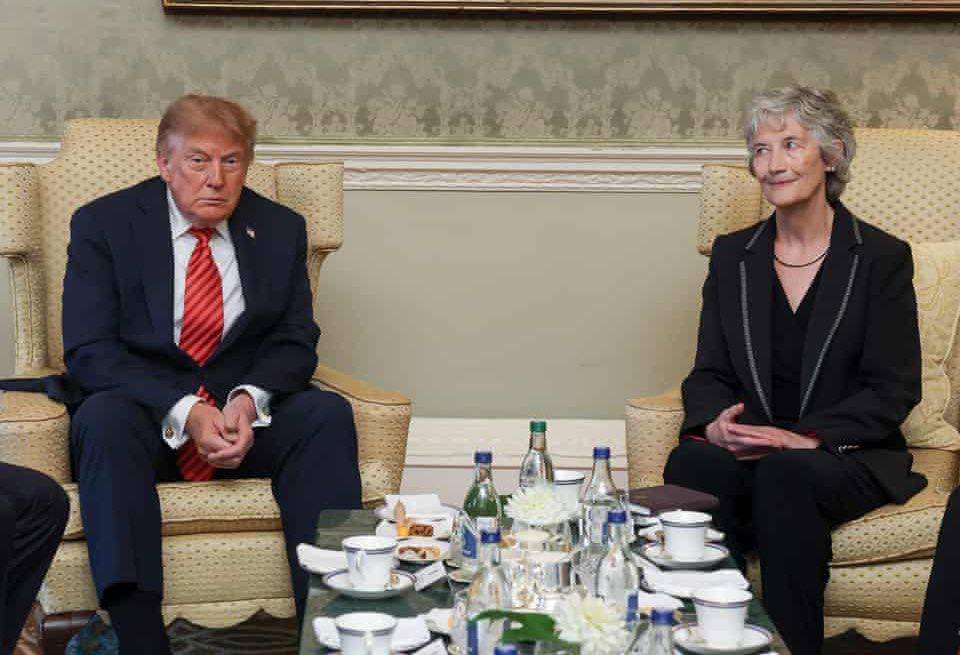
Irish President Catherine Connolly has told U.S. President Donald Trump that the normalisation of war and genocide can never be accepted, delivering a strong message on peace and international conflict during their meeting in Dublin.
Connolly met Trump at Áras an Uachtaráin on Saturday, September 12, during the U.S. president’s visit to Ireland. Following the meeting, which lasted more than 20 minutes, Connolly said she had conveyed what she described as the “strong view of the Irish people” that war and genocide must never become normalised.
The Irish president said Ireland’s own history of famine, colonisation and the violence of the Troubles gives the country a unique perspective on conflict and peacebuilding. She told Trump that Ireland’s experience also demonstrated the importance of the difficult and often lengthy process of building peace.
Connolly further highlighted Ireland’s commitment to international cooperation, including the United Nations and its peacekeeping role, as well as the country’s constitutional commitment to the peaceful resolution of international disputes.
“We are in a world facing the existential threat posed by war and climate change,” Connolly said, describing the two issues as closely connected. She added that the Irish people would strongly support those working to build peace in parts of the world experiencing war and violence.
The meeting was closely watched because Connolly has previously been critical of Trump, particularly over his policies and statements relating to conflicts in the Middle East.
Despite their differences, the encounter was conducted with diplomatic ceremony and was described by Trump as a respectful meeting. Trump did not publicly respond to Connolly’s remarks on war and genocide after the meeting.
Connolly also presented Trump with a St Brigid’s Cross, a symbol associated with peace, along with a collection of poems by Irish poet Michael Longley that includes the poem Ceasefire.
Trump’s Ireland visit also generated controversy after he expressed support for Irish reunification, saying he would “love” to see a united Ireland.
His comments attracted criticism from unionist politicians in Northern Ireland, while Irish officials stressed that the country’s policy regarding Northern Ireland had not changed. The future constitutional status of Northern Ireland remains governed by the principles of the Good Friday Agreement.
Discover more from Scoop Hub
Subscribe to get the latest posts sent to your email.