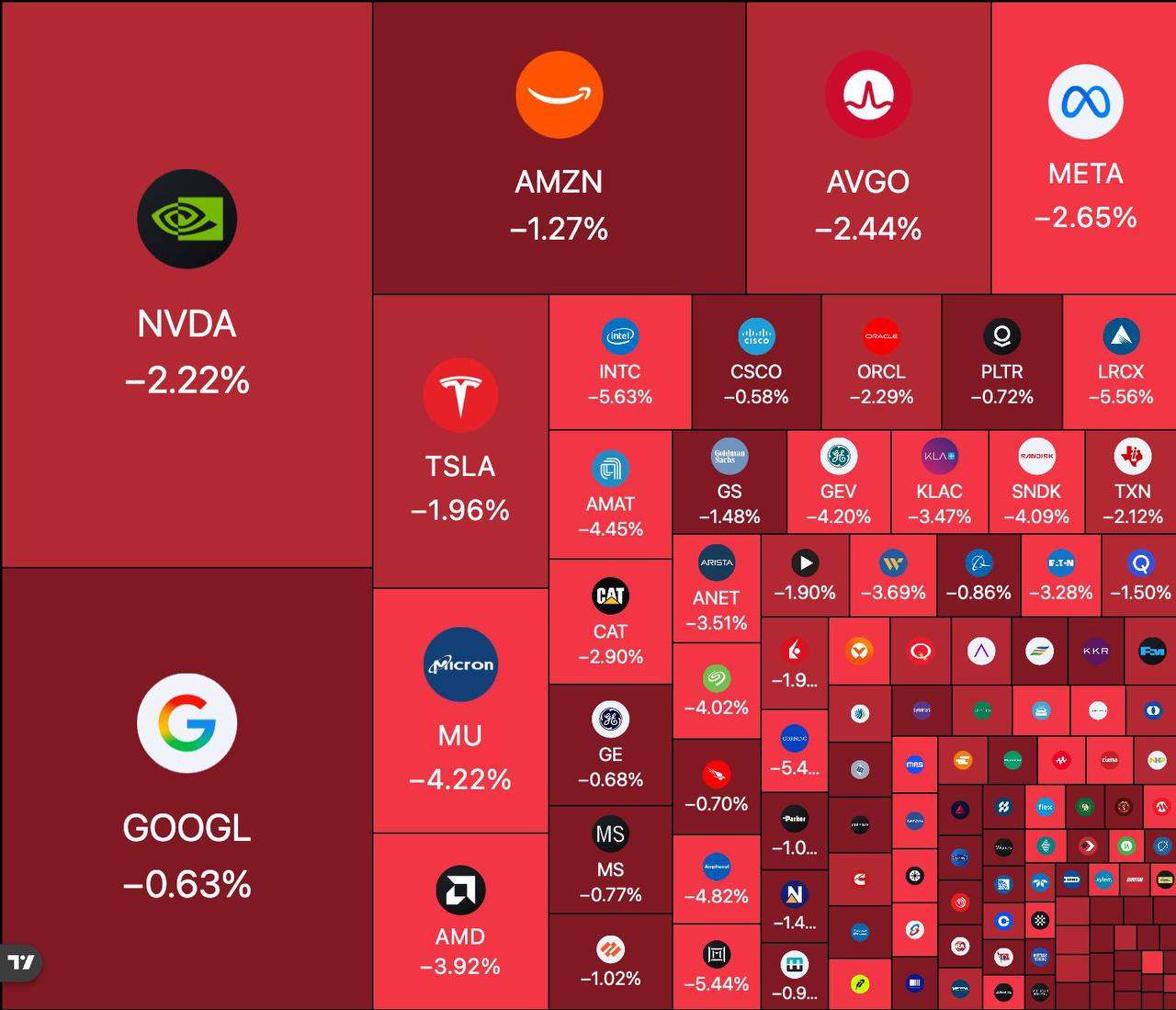
About $420 billion in market value was reportedly erased from U.S. stocks at the market open, as rising Treasury yields and renewed concerns over the bond market weighed heavily on investor sentiment.
The sell-off comes amid a broader global bond-market rout that has pushed long-term government borrowing costs to multi-year highs. On Tuesday, the yield on the 30-year U.S. Treasury briefly climbed above 5.33%, its highest level since 2007, before easing back. The 10-year Treasury yield also remained elevated at around 4.71%.
Higher bond yields can put pressure on stocks because they make government debt more attractive relative to equities while also increasing borrowing costs for companies. The impact is particularly significant for technology and other growth-focused businesses whose valuations depend heavily on expectations of future earnings.
U.S. stocks have consequently come under pressure, with the Nasdaq Composite falling more sharply than the broader market as investors reassess the outlook for interest rates and corporate financing costs. Reuters reported that the Nasdaq fell about 1.06%, while the S&P 500 declined 0.49% and the Dow Jones slipped 0.12%.
The bond-market weakness is being driven by several concerns, including persistent inflation risks, higher energy prices and growing anxiety over government borrowing. The latest escalation in the Middle East has added another layer of uncertainty, with higher oil prices raising fears that inflation could remain elevated for longer.
The rise in U.S. Treasury yields is also occurring alongside a sharp increase in government bond yields elsewhere. Japan’s 10-year government bond yield has approached 3%, its highest level since the mid-1990s, raising concerns that Japanese investors could find domestic bonds increasingly attractive compared with U.S. Treasuries.
For stock investors, the concern is that the period of unusually supportive bond-market conditions may be coming to an end. Higher yields increase the discount rate used to value future corporate earnings, potentially putting pressure on expensive stocks even when companies continue to report strong profits.
Still, the current market turbulence does not necessarily mean a financial crisis is underway. Reuters noted that despite the elevated 10-year yield, the U.S. Treasury yield curve remains relatively flat, meaning the bond market has not yet displayed some of the characteristics traditionally associated with a full-blown fiscal crisis.
The bigger question for investors is how long elevated yields will persist.
If Treasury yields continue climbing, particularly toward 5% on the 10-year note, stocks could face additional valuation pressure. A sustained increase in borrowing costs could also weigh on household spending, corporate investment and economic growth.
For now, Wall Street is watching the bond market closely. What began as a sell-off in government debt is increasingly becoming a problem for equities, putting the resilience of the U.S. stock rally to another major test.
Discover more from Scoop Hub
Subscribe to get the latest posts sent to your email.