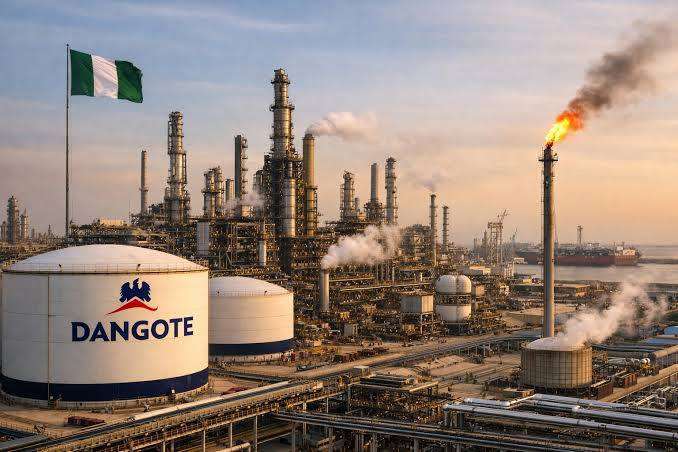
The Federal Government has described the Dangote Petroleum Refinery and Petrochemicals as a vital pillar of Nigeria’s ambition to build a $1 trillion economy, reaffirming its commitment to strengthening partnerships with the private sector to drive industrialisation, create jobs, and accelerate economic growth.
The declaration was made by the Minister of State for Industry, Senator John Owan Enoh, during a high-level visit to the Dangote Petroleum Refinery, Dangote Petrochemicals, and Dangote Fertiliser Limited in Lagos. The delegation included senior officials, directors, regulators, and heads of agencies under the Ministry of Industry.
Following an extensive tour of the 700,000-barrels-per-day refinery and the adjoining industrial facilities, the minister described the integrated complex as one of Africa’s most significant private-sector investments and a model for the kind of industrial development needed to transform Nigeria’s economy.
According to Enoh, the visit reinforced the importance of large-scale manufacturing in achieving the objectives of the Nigeria Industrial Policy, which was introduced earlier this year to expand the country’s manufacturing base and strengthen industrial competitiveness.
He noted that the Dangote Refinery represents far more than a petroleum processing facility, describing it as a symbol of Nigeria’s growing capacity to add value to its natural resources rather than relying on imports.
The minister explained that countries that process and add value to their raw materials command greater respect in the global economy, adding that the Dangote Refinery has become one of the strongest examples of that principle in action.
Enoh also said the refinery has begun reshaping global perceptions of Nigeria by helping the country transition from being heavily dependent on imported refined petroleum products to becoming an exporter capable of supplying international markets.
He pointed to recent global supply disruptions during which Nigeria was able to export refined petroleum products to markets in the Middle East and other regions, describing the development as a remarkable achievement for the country’s industrial sector.
The minister added that members of his delegation left the facility with a deeper appreciation of its technological sophistication, production capacity, and strategic importance to Nigeria’s long-term economic development.
Addressing concerns previously raised about the refinery’s single-train configuration, Enoh dismissed suggestions that it posed operational challenges. He said the visit demonstrated that production continued even during scheduled maintenance, giving officials a clearer understanding of the refinery’s operational resilience.
He further pledged that the Ministry of Industry would continue working closely with Dangote Industries Limited through initiatives such as the Industrial Revolution Work Group and ministerial engagement platforms to address challenges facing manufacturers, including access to affordable long-term financing.
The minister also commended Aliko Dangote for his contributions to Nigeria’s industrial development and for supporting the implementation of the Nigeria Industrial Policy. He described the businessman as the country’s foremost industrialist and said collaboration between government and industry leaders would be essential to achieving the policy’s objectives.
The industrial policy aims to increase manufacturing’s contribution to Nigeria’s Gross Domestic Product from current levels to approximately 20 percent by 2030 and 25 percent by 2035, positioning manufacturing as a major driver of economic growth.
Speaking during the visit, Aliko Dangote, President and Chief Executive Officer of Dangote Industries Limited, emphasized that industrialisation remains the foundation of sustainable economic development.
According to him, no country has achieved lasting prosperity without building a strong manufacturing sector capable of creating jobs, generating wealth, and supporting economic resilience.
Dangote argued that the success of local investors serves as one of the strongest signals to attract foreign investment. He explained that international investors are more likely to invest in countries where indigenous businesses are thriving and demonstrating confidence in the economy.
The billionaire businessman also revealed that Dangote Industries recently secured an unsecured and unrated bond at interest rates below Nigeria’s sovereign benchmark, describing the achievement as evidence of increasing investor confidence in credible Nigerian companies.
He said the successful fundraising demonstrated that domestic companies can attract long-term investment when government policies remain stable, predictable, and supportive of business growth.
Dangote praised Senator Enoh for his commitment to advancing Nigeria’s industrial agenda, expressing confidence that the Ministry of Industry would play a significant role in attracting investment, promoting manufacturing, and supporting the Federal Government’s economic transformation agenda.
Reflecting on the journey of building the refinery, Dangote described the project as the greatest business risk of his career. He recalled that many financial institutions and industry observers doubted the project could be completed due to challenges such as the COVID-19 pandemic, foreign exchange volatility, and financing constraints.
Despite those obstacles, he said the successful completion of the refinery demonstrates that Nigerian entrepreneurs possess the capacity to deliver projects of global scale and significance.
Dangote further disclosed that, once operating at full capacity, the refinery will account for the equivalent of approximately 10 percent of the United States’ refining capacity and process about 2.5 percent of globally traded crude oil.
He concluded by urging the Federal Government to continue supporting indigenous investors, stressing that locally owned businesses remain the country’s strongest drivers of employment, foreign exchange earnings, industrial growth, and long-term economic resilience.
According to Dangote, achieving Nigeria’s ambition of becoming a $1 trillion economy will depend largely on sustained industrialisation, consistent government policies, and strong collaboration between the public and private sectors. He maintained that empowering indigenous manufacturers and investors is essential to unlocking the country’s full economic potential and positioning Nigeria as a leading industrial hub in Africa.
Discover more from Scoop Hub
Subscribe to get the latest posts sent to your email.