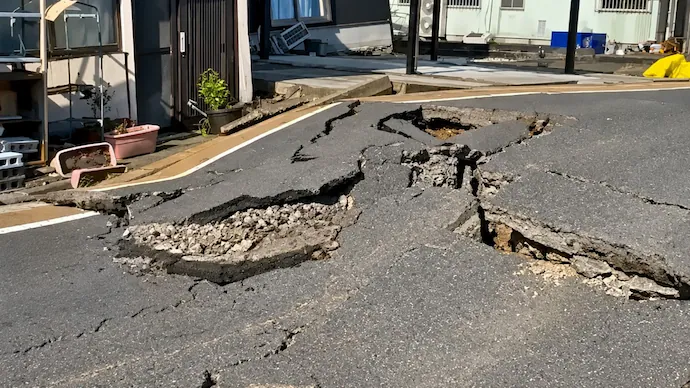
A powerful 7.1-magnitude earthquake struck Japan’s southern Kumamoto Prefecture on Tuesday, prompting authorities to issue a tsunami warning and emergency alerts across several parts of Kyushu Island.
According to the Japan Meteorological Agency (JMA), the earthquake has the potential to generate tsunami waves of up to one metre (3.28 feet). Residents living in coastal communities were urged to remain alert, follow official safety instructions, and move to higher ground if necessary.
The strong tremor triggered emergency earthquake warnings in several prefectures, including Kumamoto, Nagasaki, Kagoshima, Fukuoka, Saga, Oita, and Miyazaki, as authorities worked to assess the full impact of the seismic event.
As a precautionary measure, JR Kyushu temporarily suspended rail operations, including its high-speed Shinkansen bullet train services, to allow safety inspections and protect passengers while officials evaluated infrastructure across the region.
Japan’s energy authorities also moved quickly to assess critical facilities. Kyushu Electric Power confirmed that initial inspections at the Sendai and Genkai nuclear power plants found no abnormalities, helping to ease immediate concerns over damage to the country’s nuclear infrastructure.
There were no immediate reports of deaths, injuries, or major structural damage following the earthquake. However, emergency response teams remained on high alert as authorities warned that aftershocks could occur in the hours and days ahead.
Disaster management agencies have continued monitoring the affected areas while urging residents to stay informed through official emergency channels and avoid unnecessary travel until safety assessments are completed.
Japan is one of the most seismically active countries in the world due to its location along the Pacific Ring of Fire, where several major tectonic plates converge. The country experiences thousands of earthquakes each year and accounts for roughly 20 percent of the world’s earthquakes measuring magnitude 6.0 or higher.
The latest earthquake serves as another reminder of Japan’s vulnerability to natural disasters and the importance of its advanced earthquake monitoring and emergency response systems, which are designed to provide rapid warnings and help minimize the impact of major seismic events.
Discover more from Scoop Hub
Subscribe to get the latest posts sent to your email.