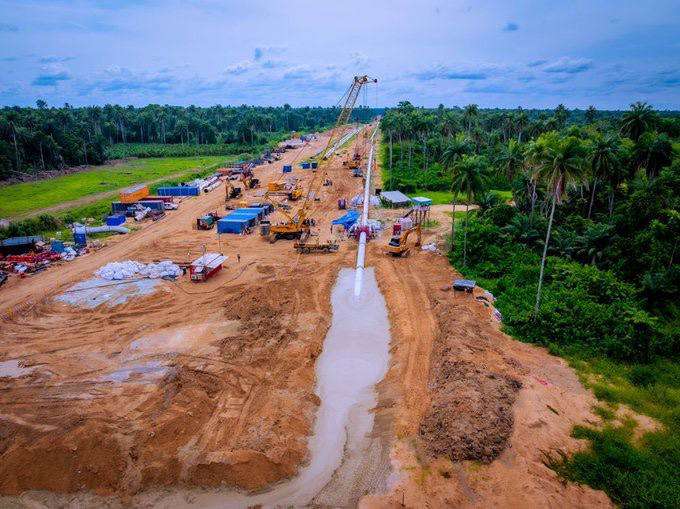
NNPC Limited has announced the successful completion of the River Niger crossing on the Obiafu-Obrikom-Oben (OB3) Gas Pipeline, marking a major breakthrough in Nigeria’s gas infrastructure development.
The Group Chief Executive Officer of NNPC Limited, Bashir Bayo Ojulari, described the achievement as a defining moment for Nigeria’s energy sector and a major step forward in strengthening the country’s long-term economic and industrial ambitions.
According to Ojulari, completing the technically demanding River Niger crossing demonstrates what can be achieved through disciplined project execution, engineering innovation, and sustained commitment to strategic infrastructure development.
The crossing, completed approximately two kilometres beneath the River Niger riverbed, was delivered by the NNPC Gas Infrastructure Company in partnership with PCE Nig. Limited using advanced horizontal directional drilling technology.
The project is considered one of the most technically complex sections of the broader OB3 Gas Pipeline initiative, which is designed to significantly improve gas transportation across Nigeria.
Ojulari noted that the milestone was the result of deliberate engineering improvements, lessons learned from previous national projects, and stronger project governance frameworks.
He explained that the OB3 pipeline is central to Nigeria’s goal of building an integrated and resilient gas transportation network capable of improving domestic gas utilization, boosting energy security, and supporting industrial expansion.
The successful River Niger crossing unlocks a critical section of the 130-kilometre pipeline, which has the capacity to transport up to 2 billion standard cubic feet of gas per day.
With this section now completed, the pipeline is expected to fully connect Nigeria’s Eastern gas network to the Western corridor while also strengthening connectivity to the Northern region through the Ajaokuta-Kaduna-Kano Pipeline system.
In the near term, officials say the project could inject more than 500 million standard cubic feet of additional gas into Nigeria’s domestic market.
This increase is expected to support electricity generation, improve gas supply reliability, stimulate industrial growth, and strengthen regional energy capacity across West Africa.
Ojulari also acknowledged the support of President Bola Tinubu and the Federal Government, crediting the administration’s Gas-to-Prosperity agenda and broader policy support for helping accelerate progress in the gas sector.
He further commended the NNPC board, project partners, and host communities for their cooperation throughout the execution of the project.
The OB3 Gas Pipeline is regarded as a cornerstone of Nigeria’s long-term energy strategy, which targets crude oil production of 3 million barrels per day and gas production of 12 billion standard cubic feet per day by 2030.
The latest milestone reinforces Nigeria’s ambition to leverage its vast gas reserves as a driver of industrialisation, cleaner energy transition, and sustainable economic growth.
Discover more from Scoop Hub
Subscribe to get the latest posts sent to your email.