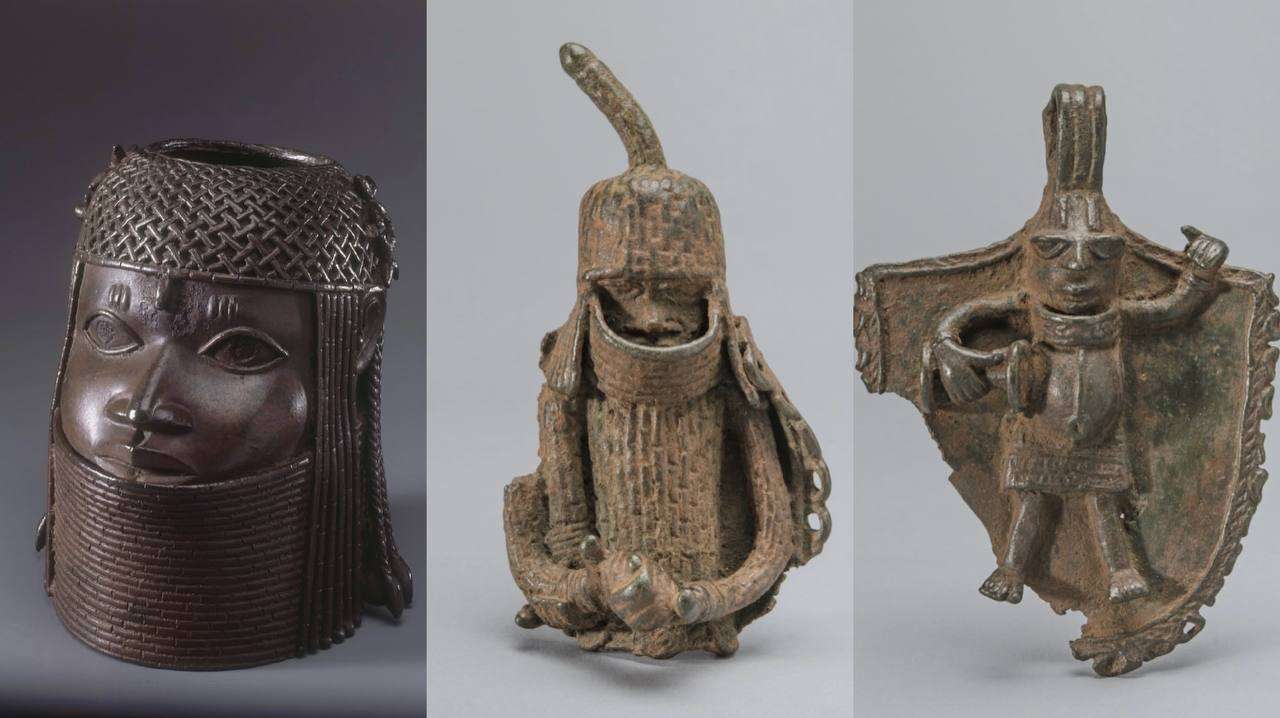
Cambridge University has officially transferred legal ownership of 116 Benin artefacts to Nigeria’s National Commission for Museums and Monuments (NCMM), marking a significant moment in ongoing global efforts to address the legacy of colonial-era looting. The decision was confirmed in a press release issued by the university on Sunday.
The artefacts, currently held in the University of Cambridge’s Museum of Archaeology and Anthropology (MAA), will be repatriated under a management agreement with the Benin Royal Palace. While most of the objects will be physically returned to Nigeria, a small number will remain in Cambridge on loan, continuing to be displayed for museum visitors, students, and researchers.
The move follows a formal request submitted by the NCMM in January 2022, seeking the return of objects taken by British forces during the 1897 sacking of Benin City. That military action, often referred to as the “Punitive Expedition,” led to the seizure of thousands of cultural treasures, many of which were later dispersed to museums and private collections across Europe.
Cambridge University’s Council approved Nigeria’s claim after receiving authorisation from the UK Charity Commission. The 116 artefacts are mainly made of brass, with additional pieces carved from ivory and wood, and are widely recognised for their historical, artistic, and cultural significance to the Benin Kingdom and Nigeria as a whole.
Reacting to the development, the Director-General of the NCMM, Olugbile Holloway, described the decision as a major breakthrough in discussions with the university. He said the return of the artefacts goes beyond the physical objects themselves, representing the restoration of pride and dignity lost when the works were taken more than a century ago.
Holloway expressed hope that Cambridge’s action would encourage other institutions around the world to follow suit, and he thanked Nigeria’s Minister of Art, Culture, Tourism and the Creative Economy, Hannatu Musawa, for her support throughout the process.
Professor Nicholas Thomas, Director of the Museum of Archaeology and Anthropology, said the outcome was the result of nearly a decade of dialogue and collaboration with Nigerian partners. He noted that the process involved sustained engagement with the NCMM, members of the Benin Royal Court, and Nigerian scholars, students, and artists, describing the exchange as deeply rewarding.
The return of legal ownership by Cambridge adds momentum to the broader international movement calling for the restitution of African cultural heritage. For Nigeria, it represents another important step toward reclaiming artefacts that are central to its history and identity, and toward reshaping how museums around the world engage with collections acquired under colonial rule.
Discover more from Scoop Hub
Subscribe to get the latest posts sent to your email.