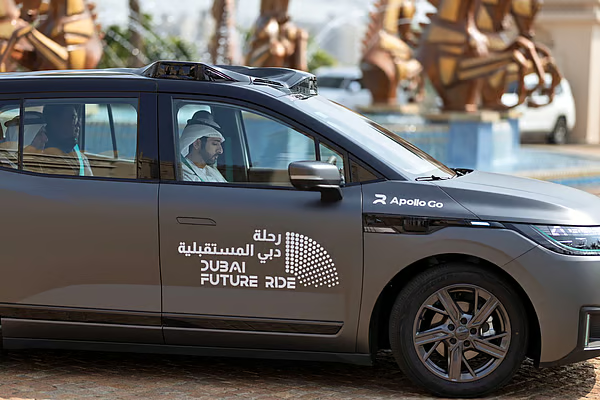
Dubai is set to begin operating its driverless taxi service from March, marking a major breakthrough in the emirate’s ambition to become a global leader in smart and autonomous transportation. The move follows the formal launch of the operational phase of fully autonomous RT6 taxi vehicles, a development that signals the technology’s readiness for real-world use on public roads.
The launch was led by Sheikh Hamdan bin Mohammed bin Rashid Al Maktoum, Crown Prince of Dubai, Deputy Prime Minister, Minister of Defence, and Chairman of the Executive Council of Dubai. To demonstrate confidence in the system, Sheikh Hamdan travelled in one of the autonomous taxis to the venue of the World Government Summit at Madinat Jumeirah, showing that the vehicles can safely navigate live urban traffic conditions.
The commencement of operations clears the way for a wider public rollout of the service, which is expected in the first quarter of 2026. During the demonstration journey, Sheikh Hamdan was briefed on how the autonomous system works, including its reliance on artificial intelligence, advanced sensing technologies, and real-time decision-making to ensure safe, efficient, and seamless mobility.
The RT6 autonomous taxi, developed by Baidu Apollo Go, represents the sixth generation of the company’s driverless vehicle technology and has been built with large-scale deployment in mind. Each vehicle is fitted with more than 40 sensors, including high-precision LiDAR, multi-band radar systems, and advanced cameras. Together, these allow the taxi to accurately perceive its environment, adapt to changing traffic conditions, and fully comply with road safety standards and traffic regulations.
Behind the scenes, the vehicles are powered by a sophisticated software ecosystem that integrates real-time traffic data, high-definition mapping, and deep-learning algorithms. This enables smooth interaction with pedestrians, intersections, and other vehicles, even in complex urban settings. The technology benefits from extensive global testing, with Baidu Apollo Go vehicles having completed over 150 million kilometres of safe driving and more than 10 million autonomous trips across multiple cities worldwide.
The initiative is the result of close collaboration between Dubai’s Roads and Transport Authority and Baidu Apollo Go, following discussions held during the World Governments Summit 2025. Remarkably, the project progressed from planning to live operations in around 10 months, highlighting Dubai’s regulatory efficiency and readiness for advanced smart infrastructure.
As part of its long-term commitment, Baidu Apollo Go has also opened its first autonomous vehicle operations and control centre outside China at Dubai Science Park. The 2,000-square-metre facility will oversee daily fleet operations, monitoring, software updates, maintenance, and safety testing. Looking ahead, the company plans to expand its autonomous fleet in Dubai to more than 1,000 vehicles, reinforcing the emirate’s vision of leading the future of smart, sustainable, and AI-driven mobility.
With driverless taxis set to begin operating in March, Dubai is taking another decisive step toward redefining urban transport and setting a global benchmark for autonomous mobility.
Discover more from Scoop Hub
Subscribe to get the latest posts sent to your email.