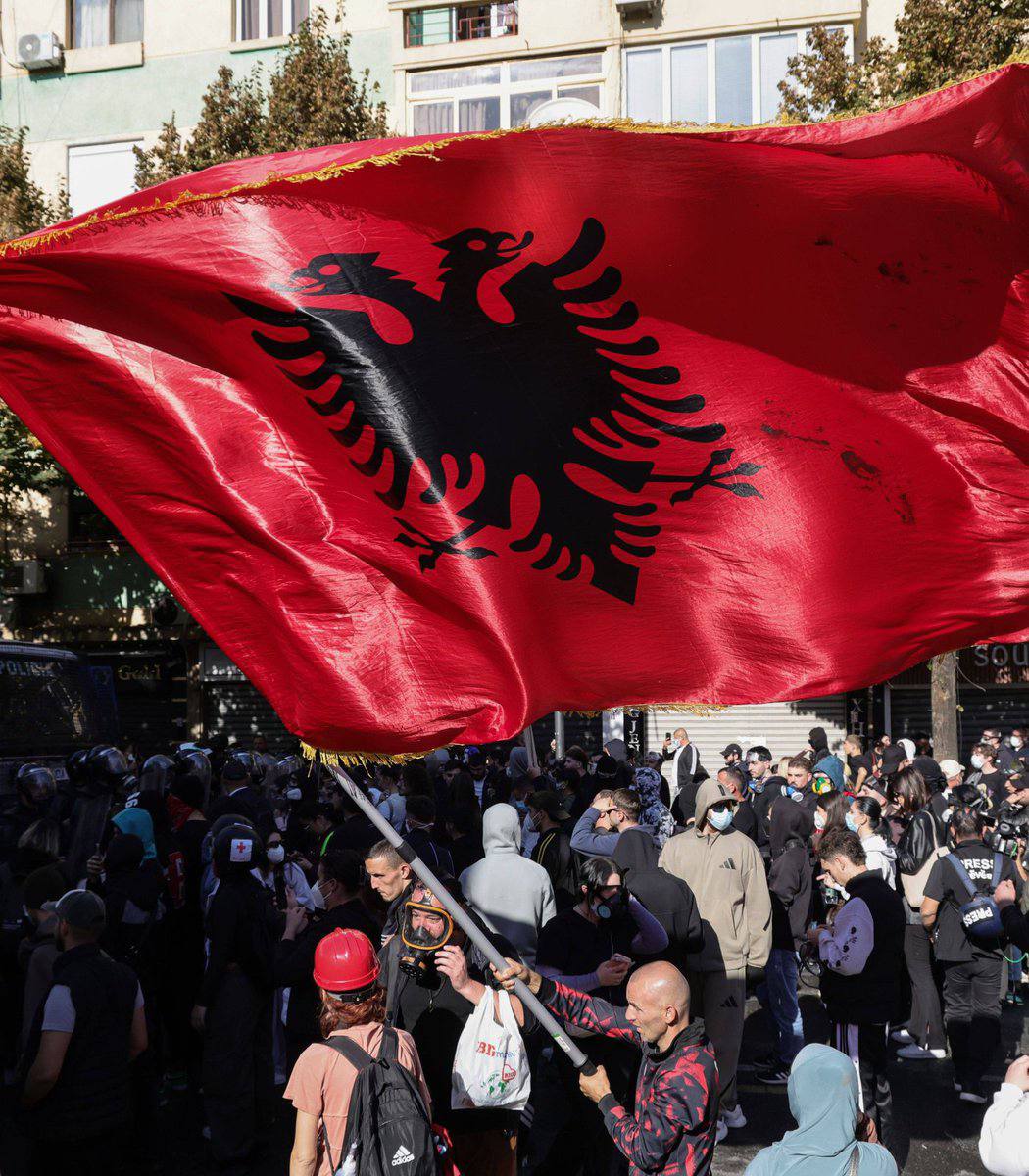
Anti-government protests in Albania have escalated into a broader movement demanding the resignation of Prime Minister Edi Rama, as anger over alleged corruption, rising living costs, education problems and controversial coastal developments continues to grow.
What began as an environmental campaign known as the “Flamingo Revolution” has attracted students and other citizens frustrated with the government. Demonstrations in the capital, Tirana, have become increasingly confrontational, with protesters clashing with police and demanding political change.
The unrest represents a significant challenge for Rama, who has served as prime minister since 2013 and won a fourth consecutive term for his Socialist Party in the 2025 parliamentary election.
The movement emerged in late May 2026, when environmental activists and local residents began protesting plans for luxury tourism developments in ecologically sensitive areas along Albania’s southern coastline.
Among the projects attracting criticism are developments associated with Sazan Island and the Zvërnec coastal area. A proposed luxury resort linked to Affinity Partners, the investment firm founded by Jared Kushner, son-in-law of US President Donald Trump, has become a particular focus of public debate.
Protesters argue that the developments threaten protected natural environments and raise questions about how public land and coastal resources are being managed.
The flamingo became a symbol of the movement because of its association with the coastal wetlands and wildlife threatened by development. Demonstrators also adopted the slogan “Albania is not for sale” to express opposition to what they see as the excessive commercialisation of the country’s natural heritage.
Initially, the campaign focused largely on environmental protection and transparency surrounding the proposed projects. Over time, however, its demands expanded beyond conservation.
The demonstrations took a new turn in October when high school and university students joined the movement in significant numbers.
Students have raised concerns about tuition fees, poor dormitory conditions, inadequate educational infrastructure and limited opportunities for young people. These grievances have merged with wider frustrations about corruption, unemployment, economic inequality and the rising cost of living.
For many young Albanians, the protests have become an opportunity to challenge what they perceive as a political system that does not adequately address their everyday problems.
The movement has also attracted people who are dissatisfied with both the governing Socialist Party and the traditional opposition. Analysts have described it as largely decentralised, with protesters coordinating through social media rather than following a single political leader.
This lack of central leadership has helped the movement bring together different groups, although it may also make negotiations with the government more difficult.
As the demonstrations grew, confrontations between protesters and security forces intensified in Tirana.
Police have used tear gas, water cannons and batons to disperse crowds, while some demonstrators have thrown stones, flares and firebombs. Government buildings and other public and private property have also sustained damage during clashes.
The unrest has resulted in arrests and injuries involving both protesters and police officers. Authorities have defended their efforts to maintain public order, while critics have raised concerns about the use of force against demonstrators.
The violence has added another dimension to the crisis. While protesters say their demands for accountability and better living conditions deserve a response, the government has condemned attacks on institutions and property. The situation illustrates the growing tension between citizens demanding political change and authorities seeking to prevent further disorder.
Corruption is one of the central issues driving the demonstrations. Protesters and critics of the government have raised concerns about alleged nepotism, transparency in public projects and the relationship between political power and private business interests.
The controversial tourism developments have become a focal point for these concerns, particularly because of the involvement of investors with international political connections.
However, allegations of wrongdoing should be distinguished from established findings. Reuters has reported no evidence that Jared Kushner was directly involved in a separate dispute over land sold for development, while the broader concerns surrounding the projects remain politically contested.
Economic pressures have also contributed to public anger. High education costs, limited job prospects, housing affordability and concerns about the quality of public services have fuelled frustration, particularly among younger citizens. Demonstrators argue that these issues reflect deeper problems in governance. Many are demanding Rama’s immediate resignation and the establishment of a technical government, rather than relying on promises of reform from the current administration.
Rama has rejected calls for his resignation, maintaining that his government has a mandate to continue its work and advance Albania’s bid to join the European Union. He has condemned violence and accused political opponents of attempting to exploit the unrest. He has also described some of the claims circulating around the protests as conspiracy theories and disinformation.
The prime minister has said he is prepared to address legitimate concerns but has insisted that violence cannot be used as a means of bringing about political change. His refusal to step down has left the government and demonstrators at an impasse. Protesters want a change in leadership, while Rama maintains that his administration should remain in office.
The European Union, meanwhile, has expressed concern about the escalation of violence and the destruction of public and private property.
Discover more from Scoop Hub
Subscribe to get the latest posts sent to your email.