President Bola Tinubu has called on the People’s Republic of China to establish a strategic partnership with Nigeria focused on geophysical data sharing, technology transfer, and technical cooperation to unlock the country’s vast marine resources and accelerate the growth of its blue economy.
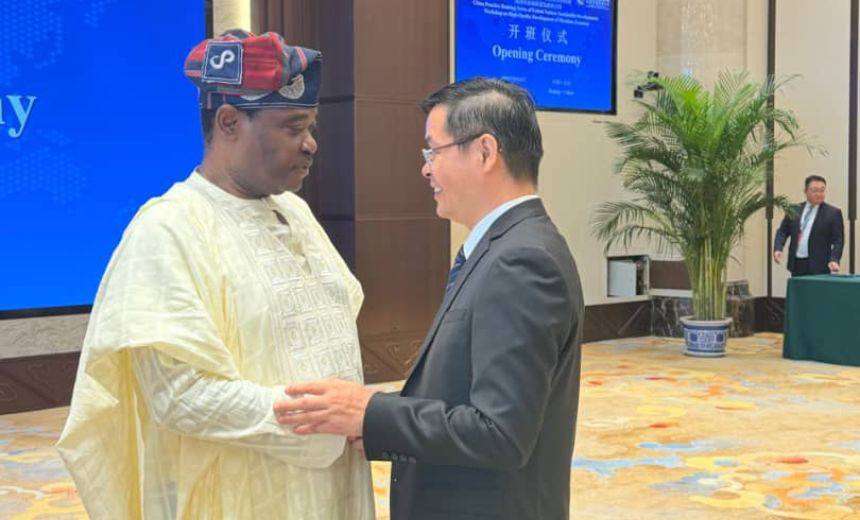
The proposal, which emphasizes collaboration over traditional foreign assistance, was disclosed by Nigeria’s Permanent Mission to the United Nations following a keynote address delivered by Nigeria’s Permanent Representative to the UN, Ambassador Jimoh Ibrahim, at the United Nations Sustainable Development Workshop on High-Quality Development of the Marine Economy held in Beijing, China.
Representing President Tinubu at the international event, Ambassador Ibrahim said Nigeria is seeking a long-term partnership built on innovation, scientific research, and knowledge exchange rather than financial aid. According to him, the Federal Government believes that access to advanced geophysical and oceanographic data will create greater economic opportunities by helping Nigeria fully harness the potential of its maritime resources.
He explained that President Tinubu’s vision is to position Nigeria among the world’s leading blue economy nations by leveraging geophysical intelligence, marine research, modern technology, and innovation to drive sustainable economic development.
“President Bola Tinubu is offering China an open invitation for partnership through geophysical data and innovation rather than aid. The future prosperity of nations lies in harnessing the immense wealth of the oceans through knowledge, technology and strategic cooperation,” Ibrahim said.
The Nigerian envoy praised China for its leadership in advancing the global blue economy and reaffirmed Nigeria’s commitment to strengthening bilateral and multilateral cooperation in maritime development. He noted that deeper collaboration between both countries could support scientific research, improve marine resource management, and enhance sustainable economic growth.
Ibrahim also highlighted the creation of the Federal Ministry of Marine and Blue Economy by the Tinubu administration as evidence of Nigeria’s commitment to developing its maritime sector into a major driver of national economic diversification and job creation.
According to him, the establishment of the ministry reflects the government’s determination to maximize opportunities within Nigeria’s extensive coastline and marine resources while promoting sustainable ocean governance.
Beyond Nigeria and China, the ambassador urged the international community to embrace innovation, artificial intelligence, sustainable financing models, and stronger global partnerships to unlock the enormous economic potential of the world’s oceans.
He also advocated for innovative financing mechanisms that would enable developing countries to build resilient blue economy infrastructure, strengthen maritime research, and implement sustainable policies for the protection and responsible use of ocean resources.
Reaffirming Nigeria’s readiness to work closely with China and other international partners, Ibrahim stressed that global cooperation will be essential in building a prosperous and sustainable marine economy capable of delivering long-term environmental and economic benefits.
He concluded with a call for decisive action, emphasizing that the opportunities within the global blue economy can no longer be ignored.
“The future is here; doing nothing is not an option,” he declared.
President Tinubu’s proposal reflects Nigeria’s growing focus on expanding its blue economy through strategic international partnerships, technological innovation, and data-driven solutions aimed at unlocking the economic value of its maritime assets while reducing dependence on conventional development assistance.
Discover more from Scoop Hub
Subscribe to get the latest posts sent to your email.