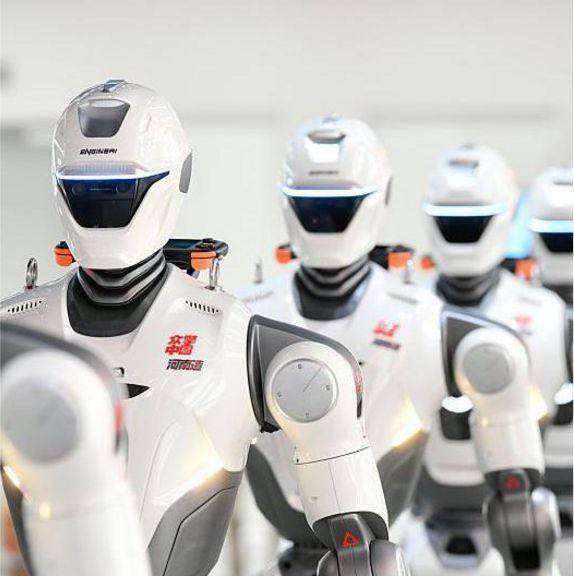
The United States has announced a major new restriction on the import of foreign-made humanoid and quadruped robots, citing growing concerns over national security, cybersecurity, and the protection of critical infrastructure. The move is expected to have its greatest impact on Chinese manufacturers, further escalating the technology rivalry between Washington and Beijing.
The decision was unveiled on Tuesday by the US Federal Communications Commission (FCC), which said the ban follows recommendations from a White House task force that examined the potential risks associated with advanced robotic technologies manufactured outside the United States.
According to the FCC, foreign-built robots equipped with sophisticated sensors, artificial intelligence, software, and internet connectivity could present cybersecurity threats capable of compromising critical infrastructure and public safety. The agency warned that such technologies could potentially be exploited in ways that endanger national security and the safety of American citizens.
The new restrictions apply to autonomous mobile robots weighing more than two kilograms, including humanoid robots and quadruped machines, commonly referred to as robot dogs. These devices rely on advanced software, sensors, and network connections to operate independently in various environments.
The announcement comes at a time when global competition in the robotics industry is accelerating, with China widely recognized as the dominant force in humanoid robot manufacturing.
Industry analysts estimate that Chinese companies currently account for roughly 85 percent of the global humanoid robot market, underscoring the country’s leadership in both production capacity and technological development.
Financial services firm Morgan Stanley projects that China’s humanoid robotics industry could grow into a $15 billion market by 2030, while analysts note that Chinese manufacturers have rapidly expanded production and significantly reduced manufacturing costs compared to many international competitors.
According to Morningstar analyst Kangyuxiao Li, Chinese robotics companies have been able to scale production much faster than their overseas counterparts, giving them a considerable competitive advantage in the global market.
While the United States has stepped up efforts to strengthen its own robotics sector, American companies are still in the early stages of large-scale deployment. Firms such as Figure AI have only recently begun introducing humanoid robots into factory production lines, while Tesla is expected to begin manufacturing its much-anticipated Optimus humanoid robot later this year.
Recent industry data from research firm Omdia highlights the widening gap between Chinese and American robotics production. Chinese companies Unitree and AGIBOT each shipped more than 5,000 humanoid robots during 2025 alone, far exceeding the output of US manufacturers, whose exports remain comparatively limited.
FCC Chairman Brendan Carr said the latest restrictions are part of broader efforts to strengthen America’s critical supply chains and reduce dependence on foreign technologies in sensitive sectors.
Despite the new import ban, industry experts believe the measures are unlikely to significantly slow China’s progress in advanced robotics. Analysts argue that the country’s vast domestic manufacturing capacity and expanding access to international markets outside the United States will continue to support its long-term growth.
Beyond its economic implications, the decision is also expected to influence diplomatic relations between Washington and Beijing ahead of a planned meeting between US President Donald Trump and Chinese President Xi Jinping later this year.
The latest restrictions follow a series of previous US actions targeting Chinese technology products, including limits on Chinese-made drones and discussions surrounding tighter controls on Chinese open-source artificial intelligence models over concerns about espionage, surveillance, and data security.
The US Department of Defense has also placed Unitree and several other Chinese technology companies on its list of firms it alleges have links to the Chinese military—claims that the Chinese government has consistently denied.
Commenting on the growing tensions, Samm Sacks, a senior fellow at the think tank New America, described the situation as a series of escalating technology disputes that could complicate future diplomatic engagement between the two global powers.
While the new rules impose strict limitations on autonomous mobile robots, the FCC clarified that stationary industrial robots used in manufacturing facilities will not be affected by the ban.
However, technology experts have noted that the broad language of the regulation could potentially extend to certain advanced consumer products, including internet-connected robotic vacuum cleaners and other autonomous household devices that meet the specified technical criteria.
Alongside the robotics restrictions, the FCC also announced a ban on foreign-made power inverters used in solar energy systems. The agency warned that internet-connected inverters could be vulnerable to remote interference or data collection, raising similar cybersecurity concerns. The move is also expected to disproportionately affect Chinese manufacturers, which currently dominate the global solar inverter market.
The latest measures signal Washington’s continued push to strengthen domestic technology supply chains while reducing reliance on foreign-made connected devices. As competition between the world’s two largest economies intensifies, the restrictions are likely to become another significant chapter in the ongoing US-China technology dispute.
Discover more from Scoop Hub
Subscribe to get the latest posts sent to your email.