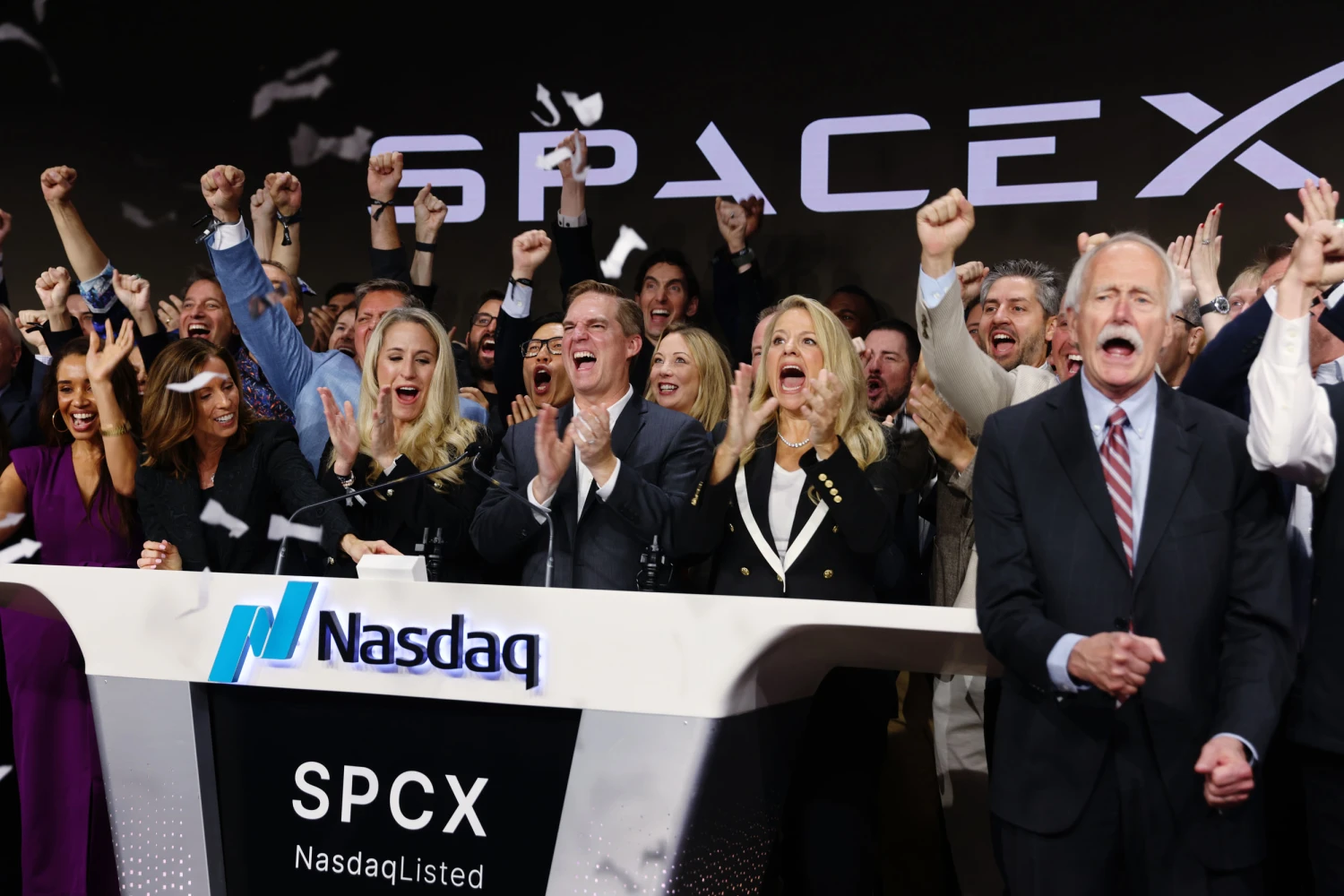
SpaceX has officially entered a new chapter in its history after making its highly anticipated debut on the Nasdaq stock exchange under the ticker symbol SPCX. The listing marks the largest initial public offering ever recorded, solidifying the aerospace giant’s position among the most valuable companies in the United States.
The company raised an extraordinary $75 billion through the offering, selling more than 555 million shares at $135 each. The blockbuster IPO values SpaceX at approximately $1.77 trillion, instantly placing it among the elite ranks of America’s corporate giants and making it more valuable than several long-established technology and industrial firms.
The historic moment was celebrated with a symbolic opening bell ceremony featuring SpaceX founder Elon Musk and company President and Chief Operating Officer Gwynne Shotwell. While Shotwell participated from the Nasdaq headquarters in New York City, Musk joined remotely from Texas, highlighting the company’s roots in innovation and space exploration.
Speaking ahead of the public listing, Musk revealed that SpaceX has been cash-flow positive for more than a decade, a milestone that reflects the company’s transformation from an ambitious startup into a global aerospace powerhouse. He explained that the decision to go public was driven by the need to raise capital for what he described as a major growth phase.
According to Musk, the funds will support ambitious projects aimed at expanding SpaceX’s footprint both on Earth and in space. Among the company’s priorities are plans to deploy more than 100,000 satellites to strengthen global communications networks and develop artificial intelligence data centers in orbit. These initiatives represent SpaceX’s broader vision of building infrastructure that extends beyond traditional aerospace operations.
Founded in 2002 as a reusable rocket company, SpaceX has become synonymous with innovation in the space industry. However, despite its achievements in launch technology, the company’s most profitable business segment today is Starlink, its satellite internet service. Starlink has rapidly expanded worldwide, providing broadband connectivity to millions of users and generating significant revenue for the company.
SpaceX’s business portfolio expanded even further earlier this year when it acquired Musk’s artificial intelligence venture, xAI. The acquisition brought together a range of assets, including AI models, advanced data center operations, the Grok chatbot platform, and the social media network X, formerly known as Twitter. The move reflects Musk’s strategy of integrating artificial intelligence, communications, and space-based infrastructure into a single ecosystem.
Despite its massive valuation and technological achievements, SpaceX’s journey has required substantial investment. Company filings show that it has accumulated a total deficit of more than $41 billion since its founding, underscoring the enormous financial resources needed to develop cutting-edge aerospace technologies and ambitious long-term projects.
The successful Nasdaq debut is not only a landmark achievement for SpaceX but also for Elon Musk, whose holdings in both SpaceX and Tesla continue to drive his personal fortune to unprecedented levels. The IPO further strengthens his position as the world’s wealthiest individual and highlights investor confidence in the future of space technology, satellite communications, and artificial intelligence.
As trading begins under the SPCX ticker, investors around the world will be closely watching how the market values one of the most influential companies of the modern era. For SpaceX, the public listing represents more than a financial milestone—it signals the beginning of a new phase in its mission to reshape communications, artificial intelligence, and humanity’s future in space.
Discover more from Scoop Hub
Subscribe to get the latest posts sent to your email.