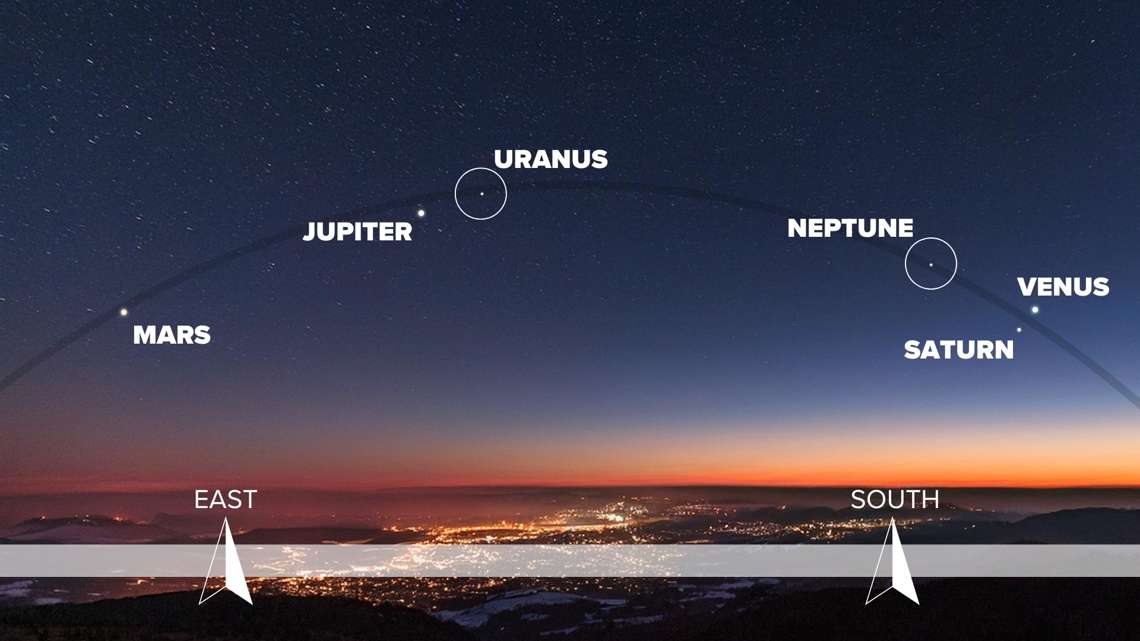
Skywatchers are in for a breathtaking treat this weekend as six planets line up in a rare celestial display that will be visible across much of the world. For a limited time, Jupiter, Saturn, Venus, Mercury, Neptune, and Uranus will share the night sky in what astronomers are calling an unusual and exciting planetary parade.
While it’s not uncommon to spot a few planets at once, seeing six together is far less frequent. According to Dr. Megan Argo, reader in astrophysics at the University of Central Lancashire, this striking alignment happens because each planet orbits the Sun at a different speed. From Earth’s perspective, their shifting paths only occasionally bring several of them into the same region of the sky at once.
“We’re seeing this alignment now because the planets’ orbits have brought them into roughly the same area of the sky from our perspective on Earth,” she explained. “While it’s fairly common to see four or five planets together, six is much rarer.” She added that although all seven major planets were visible together last year, the next full seven-planet alignment won’t occur again until 2040.
The best time to witness the six-planet alignment is in the early evening, shortly after sunset. In the UK, around 5:45pm offers optimal viewing conditions, while in the US, around 6pm is ideal. Stargazers are encouraged to find a location with a clear, unobstructed view toward the western horizon—preferably on elevated ground away from city lights.
In the Northern Hemisphere, Jupiter will appear high in the south-east, shining brightly. Near the western horizon, Mercury, Saturn, Neptune, and Venus will cluster together, forming a gentle curve across the sky. Venus will be the most luminous of the group, easily catching the eye, while Mercury will appear fainter to its right. Saturn and Neptune will sit slightly above them. Uranus, meanwhile, will be faint and positioned below the star cluster known as the Seven Sisters, also called the Pleiades.
Because Neptune and Uranus are dimmer, binoculars or a telescope will be needed to view them clearly. However, experts caution never to look at the Sun through binoculars or a telescope, as it can cause permanent eye damage. A stargazing app can also help pinpoint the planets’ exact positions in real time.
The spectacle won’t be limited to the Northern Hemisphere. Observers in the Southern Hemisphere will also see the alignment, though the pattern will appear reversed. In Australia, for example, Jupiter will be visible in the northern sky, and Uranus will sit in the north-west above the Seven Sisters. With sunset occurring slightly later, around 6:45pm local time is the best window to head outside. However, Mercury may be too close to the horizon to see clearly there, and Venus will set quickly—meaning timing is crucial.
Adding to the beauty of the moment, the Moon will also make an appearance over the next few evenings, giving observers a broader glimpse of our visible solar system.
To mark the event, NASA has released new “sonifications” using data from its Chandra X-ray Observatory. These sonifications transform astronomical data from Jupiter, Saturn, and Uranus into sound, offering a unique way to experience the planets beyond just sight.
This rare six-planet alignment is more than just a visual delight—it’s a reminder of the dynamic motion of our solar system. For a few evenings, weather permitting, anyone willing to step outside and look up will have the chance to witness a remarkable cosmic performance unfolding overhead.
Discover more from Scoop Hub
Subscribe to get the latest posts sent to your email.