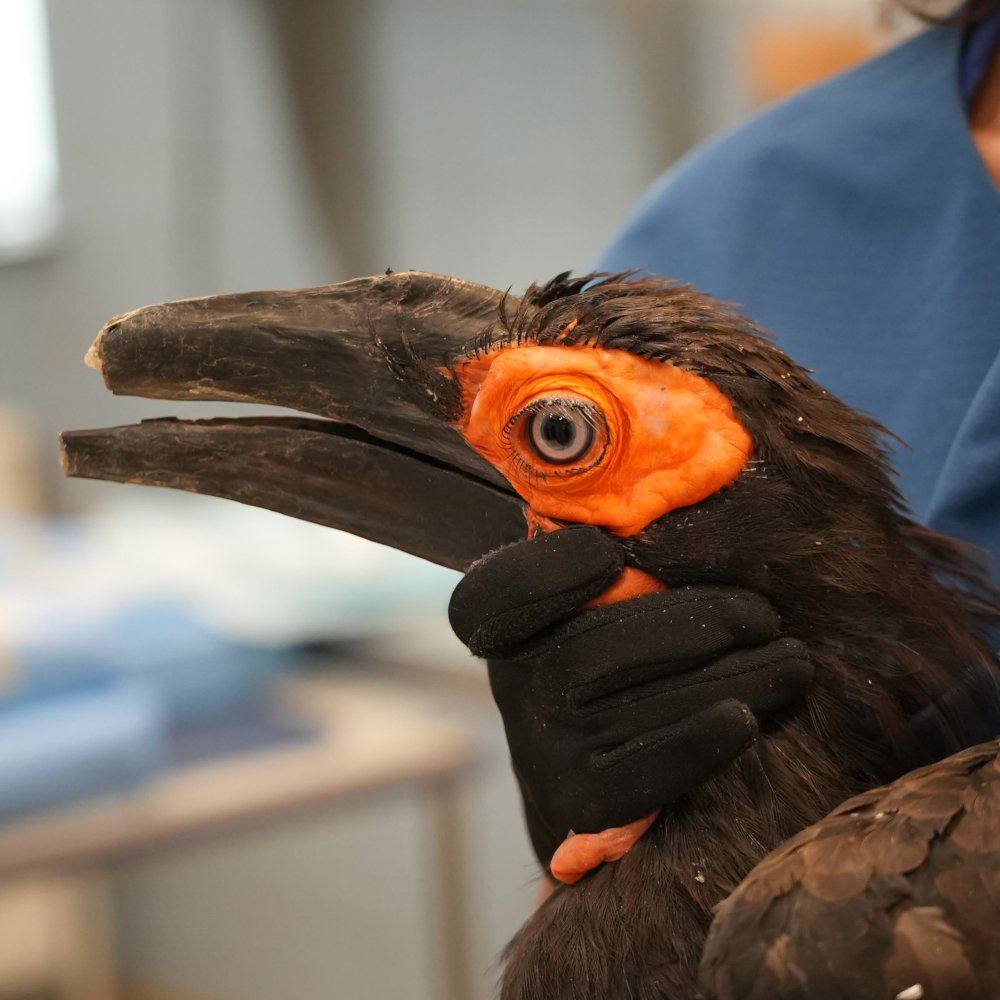
Veterinarians in the Netherlands have achieved a remarkable breakthrough in wildlife care after fitting an injured hornbill with custom-made prosthetics for both its upper and lower beak. The young southern ground hornbill, housed at ARTIS Zoo in Amsterdam, had suffered damage to both parts of its beak, making everyday activities such as picking up food and preening its feathers more difficult.
In a pioneering procedure, specialists from ARTIS Zoo, Utrecht University, UMC Utrecht and medical technology company Amnovis worked together to design and fit two custom-made, 3D-printed prosthetics. According to the zoo, this is the first known case of a bird receiving prosthetic replacements for both the upper and lower parts of its beak.
Creating the replacement beak required careful planning because every bird has a unique beak shape that must support its natural feeding and grooming behaviours.
The specialists used a CT scan of the hornbill’s head alongside preserved fragments of its original beak to reconstruct its natural shape digitally. This allowed them to develop replacements tailored to the bird’s anatomy. The prosthetics were then manufactured with 3D-printing technology and secured surgically using screws and titanium components.
The procedure was carried out by veterinary surgeons Bjorn Meij and Lucinda van Stee from Utrecht University’s Faculty of Veterinary Medicine, working with the wider team of zoo veterinarians and technical specialists.
One of the biggest concerns before surgery was whether the hornbill would accept the artificial beak and learn to use it effectively. Because the prosthetics could not provide the same sensation as natural beak tissue, the veterinary team prepared a backup plan in case the bird struggled to eat.
However, the recovery brought encouraging early results.
The hornbill began using its new beak on the same day as the operation. By the following morning, it was independently picking up a small mouse from the ground. Within a few days, it had also begun using the prosthetics to preen its feathers again. The early progress suggests that the replacement beak is helping restore important everyday behaviours that had been restricted by the injury.
For birds, the beak is much more than a distinctive physical feature. It is essential for gathering and handling food, grooming feathers and performing other species-specific behaviours.
Southern ground hornbills use their beaks to forage and manipulate prey. Damage to both the upper and lower portions can therefore affect their ability to feed independently and maintain their plumage.
Although the injured hornbill had adapted to life with the remaining parts of its beak, its quality of life was limited. The veterinary team decided that a custom prosthetic solution could give the young bird a better chance of maintaining normal behaviours over its potentially long lifespan.
The procedure could offer valuable lessons for future wildlife rehabilitation cases involving severe beak injuries. Custom prosthetics and 3D printing have been used in veterinary medicine before, including in cases involving individual beak structures. What makes this case distinctive is the reconstruction of both the upper and lower portions together.
The veterinary team will continue monitoring the hornbill to determine how well the prosthetics hold up during feeding, grooming and other daily activities. Spare components have also been prepared in case replacements are needed. The long-term outcome remains to be seen, but the early results are promising. If the prosthetics continue to function well, the approach could help inform treatment for other birds with similarly complex injuries.
For the hornbill, the operation has already made a meaningful difference: a bird whose injury had restricted its everyday life is once again picking up food and caring for its feathers. The achievement is a powerful example of how veterinary expertise and modern technology can work together to improve animal welfare.
Discover more from Scoop Hub
Subscribe to get the latest posts sent to your email.