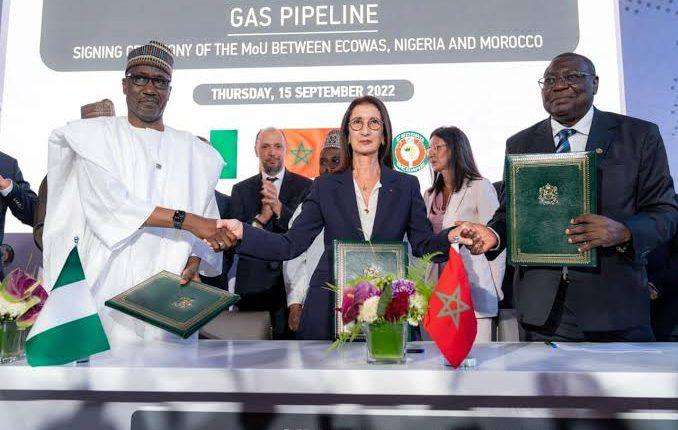
The Economic Community of West African States (ECOWAS) has taken a major step toward the realization of the ambitious Nigeria-Morocco Gas Pipeline by signing the Intergovernmental Agreement (IGA) for the African Atlantic Gas Pipeline (AAGP). The agreement was endorsed during the 69th ECOWAS Ordinary Summit held in Freetown, Sierra Leone, marking a significant milestone for one of Africa’s largest cross-border energy projects.
The newly signed agreement establishes the legal and sovereign framework required to implement the proposed 6,900-kilometre natural gas pipeline, which is expected to transport up to 30 billion cubic metres of natural gas annually from Nigeria through 13 West African coastal countries to Morocco, with the potential for future connections to European energy markets.
The Nigerian National Petroleum Company Limited (NNPC Ltd.) described the signing as a crucial breakthrough in moving the multibillion-dollar project from planning to execution. The pipeline is being jointly developed by NNPC Ltd. and Morocco’s Office National des Hydrocarbures et des Mines (ONHYM) as part of a broader effort to strengthen regional energy integration and economic cooperation.
According to NNPC, the agreement gives practical effect to the approval previously granted by ECOWAS Heads of State during their summit in Abuja in December 2024. The company believes the project will significantly improve energy access across West Africa, stimulate industrial development, deepen regional integration and establish a strategic energy corridor connecting West Africa, the Sahel, Morocco and Europe.
Preparatory work on the project has already made substantial progress. NNPC confirmed that key activities, including Front-End Engineering Design (FEED) studies, route surveys, environmental and social impact assessments, as well as the development of legal, regulatory and commercial frameworks, have been completed.
Speaking on the development, the Group Chief Executive Officer of NNPC Ltd., Engr. Bashir Bayo Ojulari, described the agreement as the foundation needed to transition the project into its implementation phase. He noted that the pipeline aligns with President Bola Tinubu’s vision of maximizing Nigeria’s vast natural gas resources by delivering approximately three billion cubic feet of gas per day to both domestic and international markets.
Ojulari reaffirmed NNPC’s commitment to working closely with ONHYM to ensure the successful execution of the project, describing it as a transformative initiative for the continent.
Also commenting on the agreement, ONHYM Director-General Amina Benkhadra said the signing reflects the shared vision of King Mohammed VI of Morocco and President Bola Tinubu to strengthen African cooperation through strategic infrastructure and energy partnerships.
The project is expected to move into another critical phase as Morocco and Mauritania complete their respective intergovernmental agreements. This will pave the way for the establishment of the Pipeline Higher Authority in Abuja and the AAGP Project Company in Casablanca, both of which will oversee implementation and prepare the project for its Final Investment Decision (FID).
Nigeria’s Minister of State for Petroleum Resources (Gas), Rt. Hon. Ekperikpe Ekpo, described the agreement as a landmark achievement that will enhance regional energy security and promote sustainable economic growth across participating countries. Representing Nigeria at the summit alongside Vice President Kashim Shettima, the minister said the signing demonstrates that the pipeline has moved beyond the conceptual stage into practical implementation.
Ekpo emphasized that Nigeria, which possesses approximately 215.19 trillion cubic feet of proven natural gas reserves—the largest in Africa—views natural gas as a critical driver of industrialization, energy security and long-term economic development.
He added that the pipeline is expected to unlock new export opportunities, attract significant investment, create thousands of jobs and support industries such as electricity generation, fertilizer production, petrochemicals and manufacturing throughout the region.
The minister also reaffirmed the Federal Government’s commitment to expanding gas production, developing energy infrastructure and maximizing the value of Nigeria’s abundant gas resources through both domestic utilization and strategic international exports.
The ECOWAS-backed agreement represents one of the most significant energy cooperation initiatives on the African continent in recent years. Once completed, the Nigeria-Morocco Gas Pipeline is expected to strengthen regional integration, improve access to cleaner energy, boost economic development and position West Africa as a key player in the global energy market.
Discover more from Scoop Hub
Subscribe to get the latest posts sent to your email.