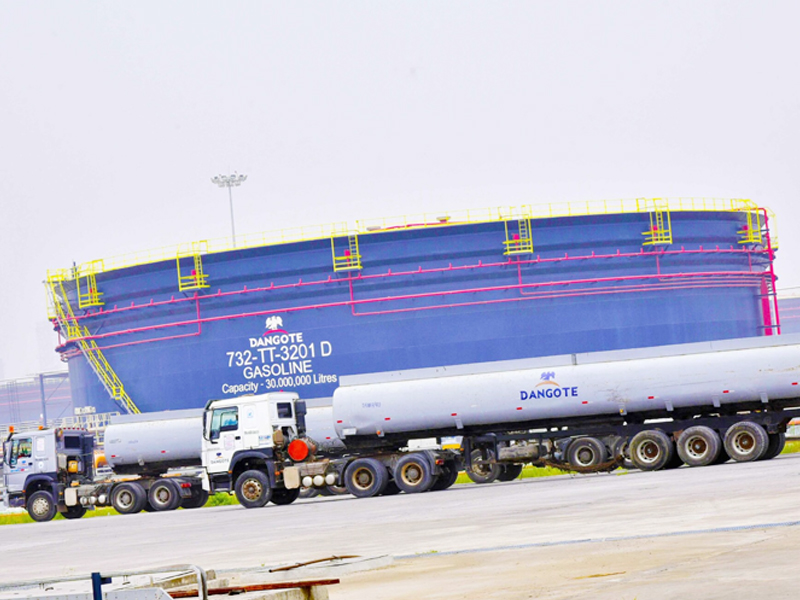
Independent petroleum marketers and energy industry stakeholders have strongly opposed the decision by the Dangote Petroleum Refinery to introduce United States dollar-denominated pricing for petroleum products, warning that the policy could increase pressure on Nigeria’s foreign exchange market, fuel price volatility, and the broader economy.
The controversy follows the refinery’s announcement that transactions involving Premium Motor Spirit (PMS), Automotive Gas Oil (AGO), and aviation fuel for gantry and coastal sales will now be priced in U.S. dollars instead of the naira.
In a communication sent to marketers, Dangote Petroleum Refinery informed customers that all previously issued payment documents denominated in naira had been cancelled following its transition to dollar-based transactions. The refinery directed marketers not to make payments using the earlier naira quotations, effectively making the U.S. dollar the new pricing currency for affected transactions.
The announcement immediately triggered adjustments across major petroleum depots, with marketers recalculating costs based on the new pricing structure. Industry data indicated that petrol prices at some depots increased by as much as ₦113 per litre, while diesel prices rose by up to ₦150 per litre in certain locations as operators factored in replacement costs.
The development has reignited debate over Nigeria’s downstream petroleum sector, with many industry participants questioning whether pricing locally consumed fuel in foreign currency aligns with the country’s economic objectives.
The Petroleum Products Retail Outlets Owners Association of Nigeria (PETROAN) criticized the move, warning that continued dollar-based fuel transactions could gradually push Nigeria toward a dollarized economy. According to the association, while Dangote Refinery has the right to make commercial decisions as a private business, such decisions should also consider their potential impact on the national economy.
PETROAN President Billy Gillis-Harry argued that allowing petroleum products sold within Nigeria to be priced in dollars could undermine efforts to stabilize the economy and create additional challenges for businesses operating in the downstream sector.
He expressed concern that marketers purchasing fuel in dollars would inevitably face increased operational costs, which could eventually be transferred to consumers through higher pump prices. He stressed that retailers are not prepared to begin selling fuel in dollars to Nigerians despite the refinery’s pricing decision.
Gillis-Harry also emphasized the importance of creating a competitive market, urging the Nigerian National Petroleum Company Limited (NNPC Ltd.) to accelerate efforts to restore full operations at the country’s refineries. According to him, increased domestic refining capacity would encourage healthy competition and help moderate fuel prices.
The Independent Petroleum Marketers Association of Nigeria (IPMAN) also expressed reservations about the new policy. The association appealed to President Bola Tinubu to intervene by ensuring the continuation of the crude-for-naira arrangement, arguing that linking domestic fuel pricing directly to the U.S. dollar could expose Nigerians to greater exchange rate fluctuations and more volatile fuel prices.
IPMAN’s National Publicity Secretary, Chinedu Ukadike, called on relevant government agencies and the Presidential Committee on Petroleum to urgently engage stakeholders and address the situation before it places additional pressure on consumers and marketers.
Energy analysts have also offered differing opinions on the policy. Some experts believe the refinery’s decision is a commercial response to the foreign exchange risks associated with purchasing crude oil and financing refinery operations. They argue that businesses should be allowed to adopt pricing models that reflect their operational realities.
Others, however, insist that petroleum products intended for domestic consumption should remain priced in naira, Nigeria’s legal tender. They warn that increasing reliance on dollar-denominated transactions could intensify demand for foreign currency, place additional strain on the exchange rate, and contribute to inflationary pressures.
The Chief Executive Officer of Petroleumprice.ng, Jeremiah Olatide, also urged the Federal Government to intervene, cautioning that widespread dollarization of petroleum transactions could further increase the financial burden on businesses and ordinary Nigerians.
As discussions continue, the issue has become another focal point in the ongoing debate over Nigeria’s petroleum deregulation policy. While some view the refinery’s decision as a legitimate business strategy in response to market realities, others believe stronger regulatory engagement is needed to ensure that commercial decisions do not undermine economic stability or worsen the cost of living.
Discover more from Scoop Hub
Subscribe to get the latest posts sent to your email.