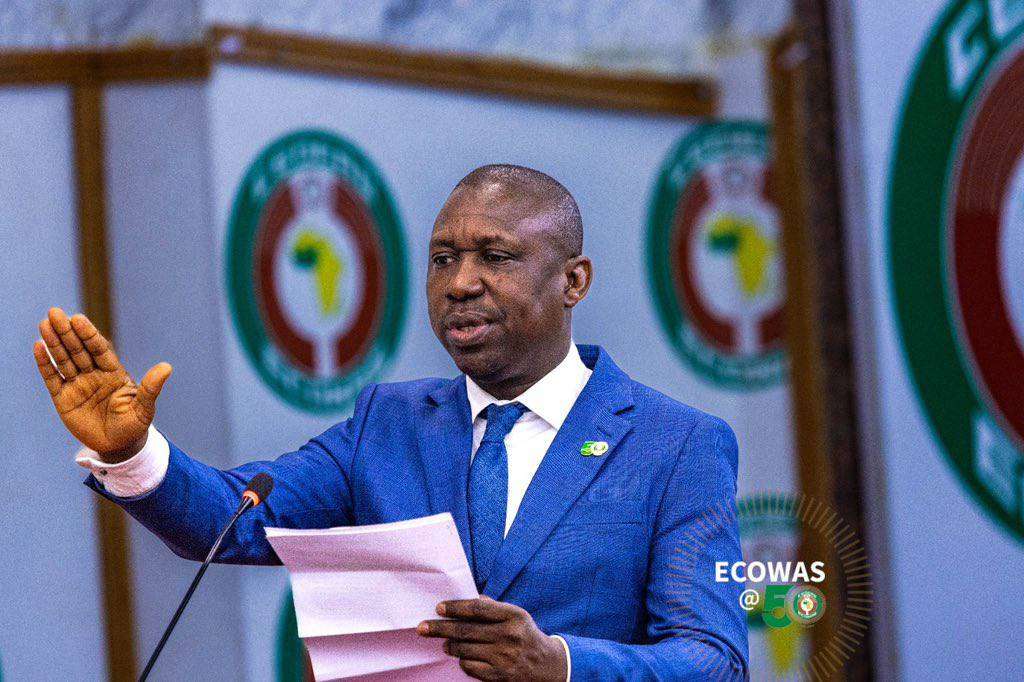
Economic Community of West African States has projected that Nigeria could emerge as the world’s fifth-richest country within the next 50 years if ongoing economic reforms and regional trade expansion continue successfully.
The prediction was made during the ECOWAS parliamentary session held in Abuja, where the bloc’s Commissioner for Economic Affairs and Agriculture, Kalilou Sylla, spoke about the long-term economic transformation expected across West Africa.
According to Sylla, the region is entering a period of major economic realignment that could significantly alter the global balance of economic power over the coming decades. He suggested that Nigeria’s growing market size, regional influence, and expanding economic sectors position the country for substantial future growth.
Sylla also projected that Ghana and Côte d’Ivoire could rank among the world’s top 15 economies within the next 25 years. He further stated that Côte d’Ivoire could eventually surpass France economically, highlighting what he described as the enormous untapped potential within West Africa.
For Nigeria, the forecast arrives at a critical period in its economic history. Although the country remains one of Africa’s largest economies, recent rankings by international financial institutions have placed it behind South Africa and Egypt in nominal GDP terms.
Nigeria’s economic journey has undergone major transformations over the decades. At independence in 1960, agriculture formed the backbone of the economy, with cocoa, palm oil, and groundnuts serving as key exports. The discovery and rapid expansion of crude oil production in the Niger Delta during the 1970s later transformed Nigeria into a major petroleum-producing nation.
However, dependence on oil revenues also exposed the economy to vulnerabilities, particularly during the economic downturns of the 1980s, which triggered inflation, debt crises, and structural adjustment reforms.
Since returning to democratic governance in 1999, Nigeria has increasingly focused on diversifying its economy beyond oil. Sectors such as telecommunications, banking, fintech, entertainment, manufacturing, and technology have expanded rapidly over the years.
Lagos, in particular, has emerged as one of Africa’s leading technology and startup hubs, while the global rise of Afrobeats has further strengthened Nigeria’s cultural influence worldwide.
Sylla emphasized that Nigeria’s future economic success will depend heavily on strengthening trade and economic integration within West Africa rather than relying mainly on Western markets. According to him, deeper regional cooperation could unlock major opportunities for growth across the sub-region.
His comments come as President Bola Tinubu continues implementing major economic reforms introduced after taking office, including the removal of fuel subsidies and the liberalization of the naira exchange rate.
While those reforms have contributed to rising inflation and higher living costs in the short term, supporters argue they could help create a more competitive economy capable of attracting investment and improving long-term fiscal stability.
ECOWAS officials also pointed to the steady rise in intra-regional trade as evidence that economic integration is already accelerating across West Africa. According to Sylla, trade within the bloc has doubled to 40 percent over the past four years despite political instability, border tensions, and currency challenges affecting parts of the region.
The prediction has sparked renewed debate about Nigeria’s long-term economic potential and the role regional cooperation could play in shaping the future of Africa’s largest population and one of its most influential economies.
Discover more from Scoop Hub
Subscribe to get the latest posts sent to your email.